

Small and mid-sized publishers are locked out of Google’s best demand. A practitioner’s guide to GCPPs, MCM, MA vs MI, and choosing the right partner.
Most publishers do not choose an ad partner. They get funneled into one, and the outcome is not always the best choice possible.
If you read ad offers for a living, you know the inbox: a new “exclusive demand” pitch most days, a guaranteed CPM that never quite lands, a reseller that calls itself a partner. The noise is real.
But for most small and mid-sized publishers, the decision that actually matters is narrower and more structural than that flood makes it look.
Here is how publishers really end up where they are, and how to make the one choice worth making.
Related articles
Two ways a monetizing publisher is born
The first is organic. A small hobby blog keeps producing content, traffic climbs, and at some point, the question becomes: will anyone pay to put ads on this?
At that stage, the publisher is not comparing fees, fill rates, or contract terms. They do not yet know what those words mean. The only question that feels urgent is whether any system will accept their content at all.
The second is deliberate. A team builds the whole stack at once (website, newsroom, marketing, financing) with real traffic potential from day one.
This publisher faces bigger decisions immediately because they will want to run direct campaigns, programmatic deals, and open programmatic demand as one blended operation, ideally through a single system, so those channels talk to each other.
For that to work well, the system ideally has a strong demand side (a DSP – Demand-Side Platform) behind it, used by as many advertisers as possible.
Two different publishers, in the end, the goal is the same, but the tools might be different.
The default road, and why it is almost always Google

When the organic publisher goes looking, they search. Usually on Google, increasingly through AI tools like Claude, ChatGPT or Gemini, almost without exception, the answer that comes back is Google AdSense.
Part of that is the channel: ask Google’s tools, get Google’s product. Most of it is plain market reality. Google’s ad ecosystem is the most technologically complete and most widely used set of ad serving, supply, and demand tools in Europe and the world.
So AdSense becomes choice number one, and the publisher quietly enters the Google monetization loop.
This is not a mistake. For most publishers, it is the rational default. The real question is what happens when you hit its ceiling.
What are you actually choosing between
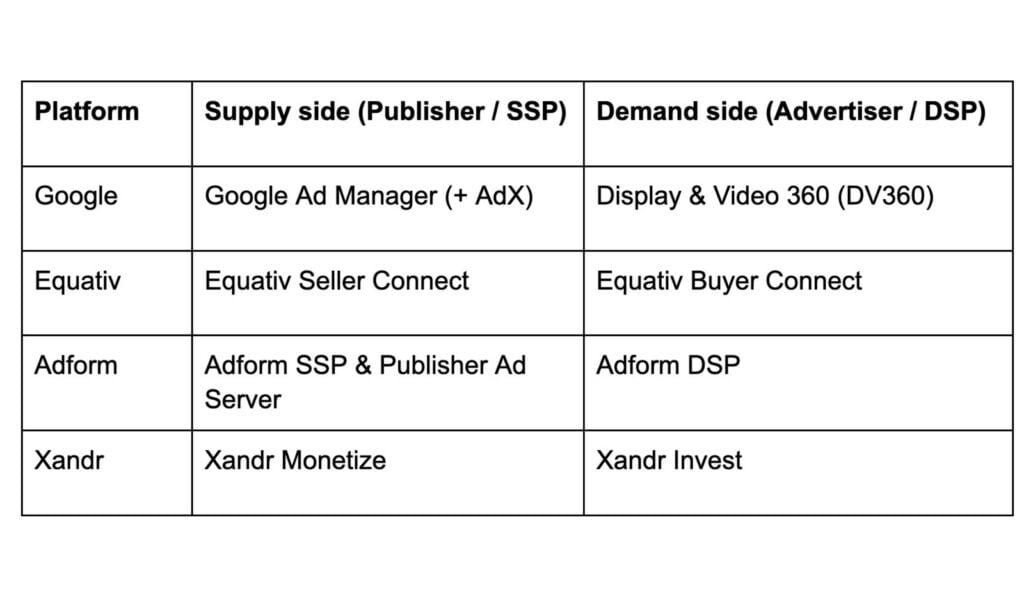
Strip away the pitches, and there are only a handful of real end-to-end ecosystems. Each has a supply side (where you, the publisher, sell) and a demand side (where advertisers buy):
And the market is not balanced. By share of use (FatChilli estimates):
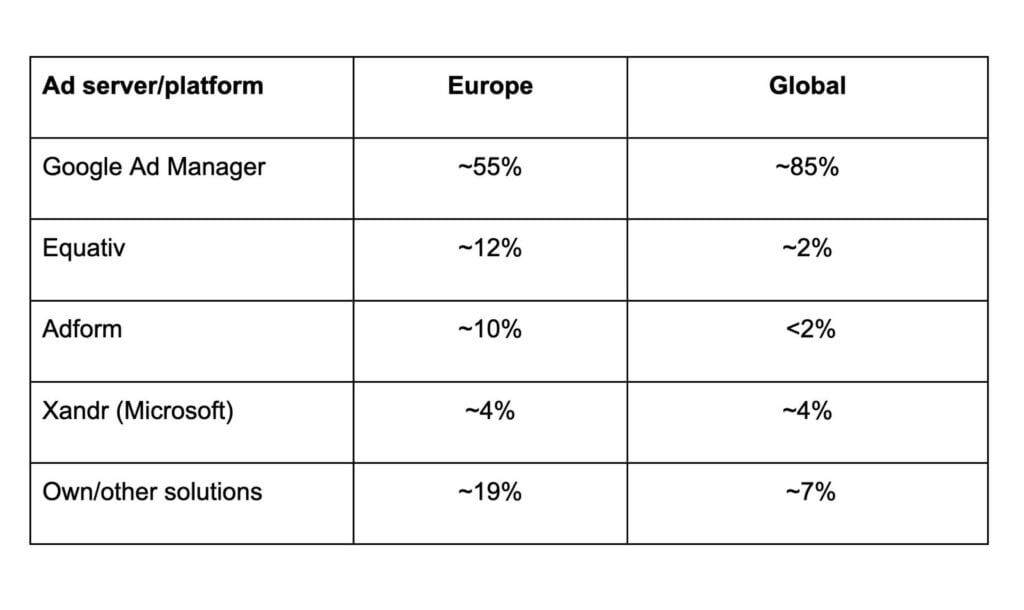
The takeaway is blunt: of the systems that can monetize content at scale, Google dominates. For most publishers, it is option one, and often the only option that works.
The ceiling for small and mid-sized publishers hit
The real prize inside Google’s stack is not AdSense. It is Google Ad Exchange (AdX), the premium demand source built directly into Google Ad Manager.
Here is the catch. You cannot simply switch AdX on. There is no “Activate AdX” button. Access is invitation-only, granted on a case-by-case basis, against criteria Google does not publish.
You can buy your way in through the paid tier of Google Ad Manager, but that runs into thousands of euros a month, which rules it out for almost every small and mid-sized publisher.
Many never reach the impression volumes that would justify it. So the typical publisher is stuck: inside Google, but locked out of Google’s best demand.
The route around the ceiling: a GCPP with MCM
There is a documented way around it. A Google Certified Publishing Partner (GCPP) that holds MCM rights (Multiple Customer Management) inside its own Ad Manager can extend AdX access to other publishers, who join as “child publishers.”
To qualify, you must pass Google’s criteria, not just the partner’s. The encouraging part: If you already run AdSense, you have cleared Google’s core verification.
AdX review is stricter, and the exact bar is not public, but a publisher with authentic content who plays by the rules (no clicking your own ads, nothing on Google’s prohibited content list) generally clears it.
The important thing: AdX behaves the same whether you reach it through a GCPP or a hold. The only difference is a revenue share.
The GCPP takes a cut of AdX revenue, negotiated between the two of you, typically 10 to 20 percent, depending on your inventory and the formats you run.
Manage Inventory or Manage Account: pick the right model
If you take the GCPP route, you choose one of two cooperation models.
Manage Inventory (MI): You run on your partner’s Ad Manager, using their setup and settings. Right for publishers with no Ad Manager of their own and no plans to run one.
Manage Account (MA): The partner switches AdX on inside your own Ad Manager, and you stay responsible for setup and management. Right for publishers who already have a configured Ad Manager and just need the AdX demand added.
Four questions decide which one fits:
- Do you have your own Google Ad Manager?
- Do you have your own programmatic deal partners?
- Do you have your own open bidding partners?
- Do you need an extended reporting environment?
Running Ad Manager and only want AdX? Go with the MA option.
None of the above and no appetite to manage a stack? Choose Manage Inventory (MI).
What working with a serious partner actually looks like
A credible partnership is a process, not a contract you sign and forget.
In practice, it runs like this:
1. Internal vetting of the publisher: content segment, publishing regularity, traffic checked against available sources.
2. An MA or MI invitation is sent to the publisher’s email and accepted.
3. A Child publisher account is created in the partner’s MCM, with its own network code.
4. The publisher adds the partner’s ads.txt records to their own ads.txt.
5. The site is submitted to Google, which judges its eligibility for AdX demand.
6. On approval, the partner builds the ad positions and formats and delivers the scripts to implement on the site.
7. Scripts go live; ads start serving.
8. The publisher gets a reporting dashboard to track performance.
9. If Google rejects the site, the reasons are fixable, and the site is resubmitted.
Support should not be metered or upsold afterwards. With a revenue-share model, it is already in the partner’s interest to keep your inventory healthy, so ongoing support should come as part of the deal.
So how do you actually choose?
For most small and mid-sized publishers, the choice is not “which of the 30 offers in my inbox.” It is a short, structural set of questions:
- Are you trying to reach AdX, or do you genuinely need a different ecosystem?
- Do your content and traffic clear Google’s bar (authentic content, clean behaviour, no prohibited categories)?
- Do you already own and run an Ad Manager, or do you want someone to run it?
- Is the revenue share in the normal 10 to 20 percent band, and tied to the value and formats you actually bring?
- Is support included, or will it become a line item later?
Answer those honestly, and the flood of daily offers shrinks to a handful of partners worth a real conversation.

Note
FatChilli is one of the few partners that holds MCM and can open AdX demand to small and mid-sized publishers, with a fair revenue share and support included as part of the cooperation. If you want to know whether your site clears the bar, get in touch.
Enjoyed the post? Share it.

A specialist in monetizing digital space using various display advertising formats. Data designer collection structures for analytics tools.








FatChilli's Solutions