
Some Slovak publishers lost tens of percent of their traffic in a year as Google’s AI answers took over search. What the audited data shows, and who is safe.
* Originally published in Denník N (Slovakia), 30 July 2026
Slovak online media have not had a shock like this in a long time. The market was fairly stable, and site traffic moved mainly with the season and with events such as elections, sports fixtures or other big stories.
As the country’s most visited news website, Aktuality.sk has long held the number one spot, leaving other media outlets to battle it out each month for the remaining positions. It used to be a highly predictable landscape, but that has all changed.
Audited traffic measurement by gemiusAudience (Note: the only audited traffic measurement on the Slovak market) shows that the numbers for several Slovak online media have fallen, in some cases by tens of percent compared with last year.
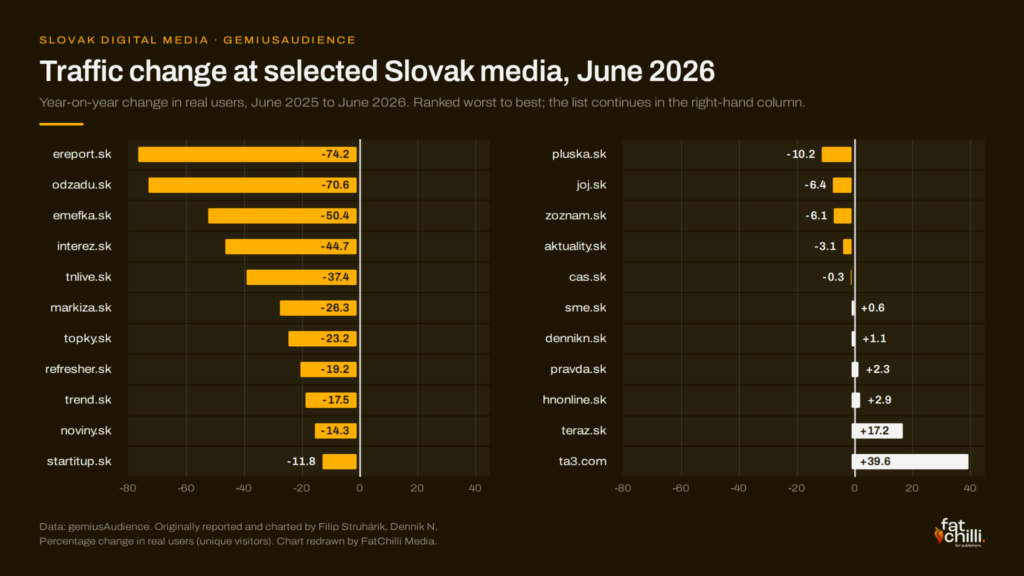
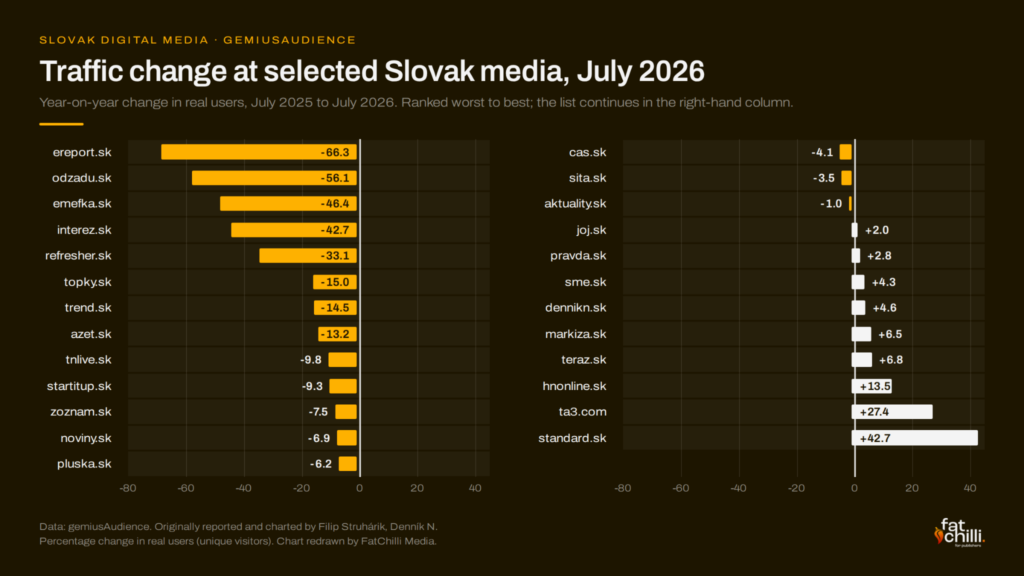
The pro-government site Ereport fell 74 percent year-over-year in real users in June. The entertainment portal Emefka fell 50 percent, the tabloid Topky 23 percent, and the business title Trend by almost 18 percent. Many other outlets also recorded double-digit declines.
This is not a one-month blip. The same trend shows in the data for the whole second quarter of this year, and it continues into July.
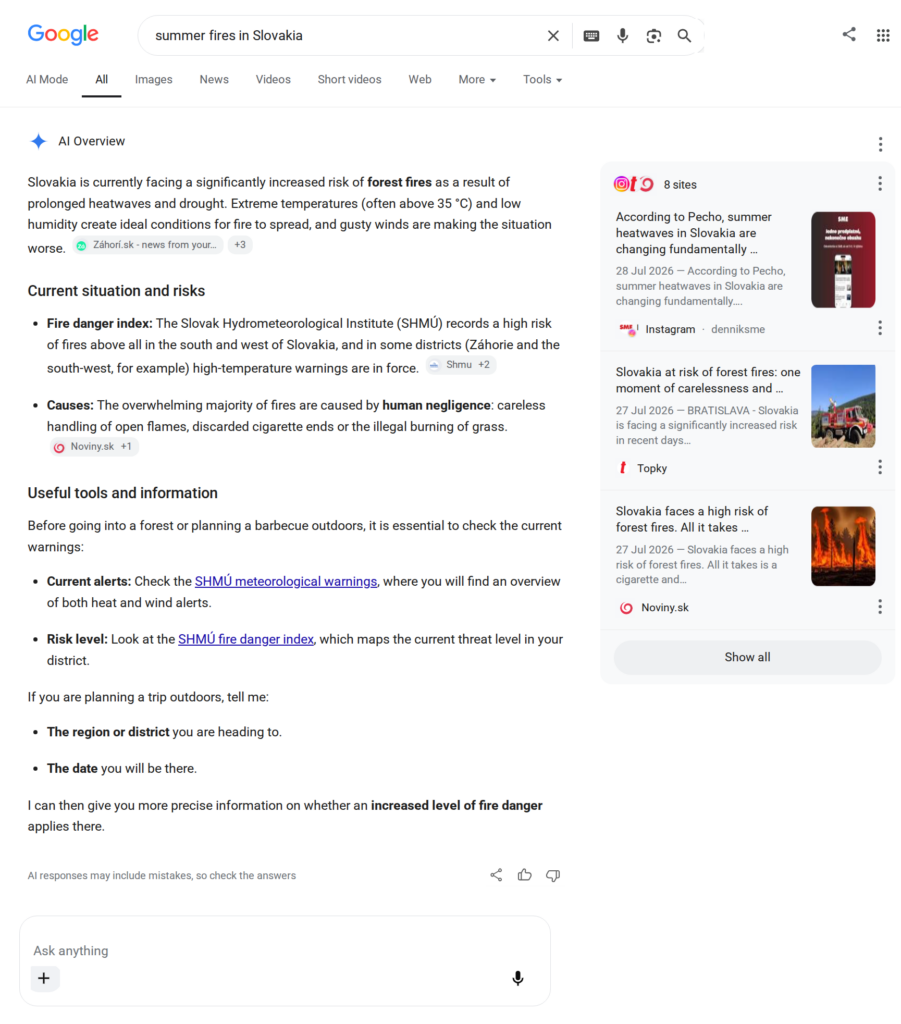
One cause is a change at Google, which increasingly serves answers directly in the search results using AI. Users no longer have a reason to click through to the source the information came from.
➡️ Subscribe to our newsletter for more publisher stories and strategies straight into your inbox.
The media confirm the decline
It’s worth noting up front that the declines described in this article and shown in the chart reflect total site traffic. Visits from Google account for only a portion of this, and that share varies by outlet.
Newsrooms know their own traffic data from search engines but do not publish it. The audited measurement only shows us which sites are losing total traffic. It does not mean Google is always to blame.
One exception is the news portal TN Live, which belongs to the broadcaster Markíza. Its June traffic fell 37 percent year-over-year, but in this case we know the bad numbers are not caused only by changes in search.
In June, Markíza shut down its TV Noviny website and replaced it with a new brand, TN Live. The switch did not go well. TV Noviny used to have 1.1 to 1.3 million real users in a given month. The new domain reached only 700,000 in June. Changes at Google may have hurt Markíza too, but it suffered more from the botched migration.
For the country’s most-watched broadcaster the website is not that important. The main part of its business is television advertising, and then the streaming platform Voyo. “Thank you for the opportunity to comment, but we have decided not to take it,” Markíza replied to our questions.
Interez is a different case. The portal aimed at young readers fell almost 45 percent year-over-year in June. It did even worse on daily traffic. In June 2025 it averaged 220,000 real users a day and used to be in the top ten most visited Slovak sites. In June 2026 it had 47,000 unique users a day, 79 percent fewer. On some days Interez struggles to make the top twenty, and that is at a time when its competitors are falling too.
“After this year’s updates carried out by Google we recorded a drop in traffic, which we are actively addressing on the technical side. We will not comment on the details. These are internal and commercially sensitive matters that we do not disclose,” said Matej Mensatoris, editor in chief of Interez.
Interez belongs to the Startitup media group, which also runs the sites Emefka and Odzadu. In a statement the group confirmed that its traffic had fallen but would not go into detail.
Gábor Boros, director of the rival portal Refresher, is more open. He also confirmed a drop in clicks from Google. “If we are talking purely about traffic from organic search, then yes. Year-over-year it is roughly 20 percent,” Boros said. “Almost all of that search decline is caused by the drop from Google, since it is the strongest player.” In his view the changes have not yet affected how Refresher performs economically.
“Recently we have seen more pronounced changes in the structure of traffic from internet search engines including Google, especially in the last few months, when the trend has deepened noticeably,” adds Martin Mác, director of Zoznam, which owns the news site Topky along with other lifestyle and special-interest sites. “We do not publish exact figures for commercial reasons. We can confirm, though, that in some traffic segments we are talking about tens of percent year-over-year, which is a noticeable shift.”
According to Mác the drop in traffic is showing up in revenue too, although higher advertising prices are partly softening the effect. “Overall it is a noticeable negative impact that is forcing us to look for new ways to reach our audience effectively and to diversify our revenue sources,” he said. He admitted the situation has also required cost savings, including staff.
Mác also warns that changes in traffic cannot be attributed to Google alone, because user behaviour is shaped by several things: the growing popularity of social networks, video platforms, mobile apps and artificial intelligence tools.
“In our own data we also see that alongside search, traffic from social networks is falling noticeably, so this is not an isolated phenomenon tied to one source. For some magazines we are even recording a bigger drop in traffic from social networks than the one caused by the reduction in traffic from Google Discover, which confirms that the change is not only about search but about the whole way users consume content.”
According to Mác, people expect a fast, direct answer, or content right there on the platform they are using, without having to visit another site.
Related articles
Large news media are holding up so far
For years the relationship between Google and the media was lopsided but more or less worked. Google systematically crawls the whole available internet, collects the content of websites and on that basis can offer every user relevant search results. In return the media got traffic they could turn into revenue from advertising, subscriptions or the other services and products they offered.
Google got the data free, the media got an important source of traffic. The relationship suited both sides, though not everyone was happy.
Many publishers wanted Google to pay them for using their content. They argued that the search engine was making money off them and they were not getting enough in return. In some countries the negotiations were sharp and led to legal disputes. Google made small concessions that did not hurt it much and in the end did not cost it much either. It offered some media licensing fees through the News Showcase programme, for example. Everyone involved got used to the idea that the situation was not ideal but that this is simply how the internet works.
The problem started when Google began using AI to process content from publishers, recently adding short text summaries called AI Overviews to its search results. Now, users get their answers instantly without clicking on anything. Links to the sources are still there, but if the summary does the job (which it increasingly does), people have no reason to click through.
So the media keep supplying Google with their content for free. The traffic that was their only compensation is gradually disappearing.
“The strongest effect we see is with content that gives short factual answers or responds to simple user questions,” says Mác of Zoznam.
Matěj Hušek of the Czech company Seznam told the Novinářské fórum 2026 conference in Prague that the negative effect is felt most by sites built on so-called long-tail content, meaning recipes, how-to guides or database pages. “Generative AI can produce a perfect summary that is far better than what site operators typically have. That is hard to compete with,” Hušek said of sites that have long lived off search traffic.
Slovak news media have not yet seen big falls. Portals such as Aktuality, SME, Pravda, HNonline, TA3, Teraz and Denník N are holding at similar numbers to a year ago, and some have improved. Even these sites, though, may have sections beneath them that will no longer do as well as they used to.
Denník N, for example, gives Google’s search engine only the unlocked part of its articles, so it was never as successful in search as media without subscriptions that handed Google all of their content.
“Fluctuation in website traffic is a normal thing. In our case, the swings are minimal, and we have long been trying to diversify our traffic sources,” said Adam Zavřel, head of online news at the broadcaster Joj. Joj’s website fell 6 percent year-over-year in June, its news site Noviny.sk by 14 percent.
It is not known how the current situation on the market has affected disinformation outlets, since they operate non-transparently and do not have their traffic measured in the gemiusAudience audit.
How Google responds
According to Google, user behaviour is changing, and it is not only about the arrival of AI. People are searching more for forums, videos, podcasts and posts with authentic opinions. Traffic is therefore moving away from the media to other sites, the search engine says.
“People are increasingly drawn to using artificial intelligence. Our generative AI features in search are designed to give them a useful overview of a given topic while displaying links to the web as visibly as possible,” said Alžbeta Houzarová, communications director for Google in our region.
“We are improving our AI tools and features very quickly so that we help people discover the web easily and connect them with sources that are valuable to them. Through them, we send billions of clicks to websites every week,” Houzarová added.
Google sent a similar answer to the one it gives media abroad on this topic. It provided no specific data for the Slovak market. It also did not answer the question of what the click-through rate to websites is from standard search results, or what the click-through rate is to the sources listed in AI overviews.
Google defends itself by saying that in AI answers it shows users a larger number of links, and that it has added page previews. People can also personalise their search and choose preferred sources that should appear in higher positions.
The media criticise Google for not sending two separate “robots” to websites, one for search and one for AI. It is the same one, so site owners have no way to block only the data collection for artificial intelligence. If they decide to cut the bot off, they also drop out of ordinary search results and lose all their organic traffic from Google.
In the United Kingdom, this situation is changing. In June, the country’s competition regulator, the CMA, ordered Google to give publishers the option of blocking content collection for AI separately, without losing traffic from search.
Google is now testing that option in Britain. It is not yet known whether or when it will launch it globally.
Read also
Media consider leaving Google
Slovak media are not alone in having problems with falling traffic from Google search. It is happening worldwide. Frustration has reached the point where significant foreign media are considering leaving the search engine altogether, the Wall Street Journalreported.
USA Today is weighing whether to block Google’s bot after organic traffic from the search engine fell 18 percent year-over-year in June. “It is high time to take a stand and say that enough is enough,” said Mike Reed, chief executive of USA Today. The company is reportedly already preparing for a future without revenue from Google traffic. It is also suing Google over monopolistic behaviour.
The American publisher Penske Media, which owns magazines such as Variety and Rolling Stone, is also suing Google over summaries created with AI. According to the suit, they use its content illegally and cut its traffic.
Politico and the Reuters agency are also thinking about blocking Google. “We are weighing the economic trade-offs between search and summaries created by artificial intelligence,” said Reuters president Paul Bascobert.
People, which publishes dozens of lifestyle magazines, is also reassessing its relationship with Google. “Turning them off and blocking them completely is 100 percent on the table,” said Neil Vogel, chief executive of People.
The social network Reddit is also reviewing its cooperation with Google. It receives 60 million dollars a year for letting the technology giant use Reddit’s content to train its AI models. Reddit no longer sees that deal as advantageous.
Google has problems in Germany too. The media regulator there ruled that AI summaries are also subject to German media law. And in June, a court in Munich concluded that Google can be held responsible for inaccurate information in AI overviews. The search engine does not limit itself to displaying third-party content but generates new content itself, so it should be responsible for all the errors the AI produces. This could be an important precedent for the future.
What happens next
For several outlets, a traffic drop in the tens of percent is a serious threat. If they want to survive in the changed environment, they will have to rethink their strategy. They have to find what they can offer readers who already get answers straight from Google.
According to Mác of Zoznam, publishers need to invest in quality original content, build strong brands and strengthen the direct relationship with their audience through their own channels. “At the same time, we think it is important for publishers to share their experience across the industry and to act together when negotiating terms with the big technology platforms. Individually, each outlet has only limited bargaining power against players like these,” Mác said.
“It is practically a media house’s duty to follow current trends and use innovative options, which need to be seen as an opportunity, not an obstacle,” urges Zavřel of Joj.
Boros of Refresher also sees the future in quality content that AI cannot offer. For him, that means content that is original and exclusive, with added value, not just an interpretation of facts or of content available elsewhere.
Publishers also need to build a good relationship with the reader and diversify their revenue sources, he says. “Change is the only constant and publishers know it. All publications have to adapt gradually to the new reality and to the days ahead,” Boros adds.
➡️ Subscribe to our newsletter for more publisher stories and strategies straight into your inbox.
Enjoyed the post? Share it.

A Slovak journalist and editor currently working at Denník N. He is a 2026 European Press Prize laureate and a multi-award-winning media professional recognized for his contributions to digital journalism. He collaborates with Reporters Without Borders, serves on the Konšpirátori.sk evaluation board, and is the author of 'What's new in the media'.









FatChilli's Solutions