
At Denník N, 7 percent of readers bring in 70 percent of revenue. What that means for how publishers should think about growth.
In all of the history of media and news, there was never such a turbulent stretch as the last twenty years. Most media have gone through a digital transformation: from print to digital, from linear to on-demand and digital broadcast, and from ads-first to subscription-first revenue.
For newspapers, it took nearly 500 years to evolve, find the right business models and develop the medium, from the printing presses of the 1500s until the arrival of the internet and the shift to digital that happened only recently, not long after the millennium.
In the 2010s, audiences in most Western countries started relying more on digital news than on printed newspapers. The early 2020s brought the shift from owned platforms to social media. And we are already discussing what AI chatbots will do to media consumption.
All of this to say that modern newsrooms that want to survive have had to keep evolving their business models. Think of this era as adaptive revenue building. Yes, at the core you have direct reader revenue: subscriptions, memberships, donations and so on.
And for a very few, that might even be the only goal: not to rely on any revenue other than money coming directly from the audience. Admirable, but possibly a bar too high for most news and media outlets.
I believe the sustainable future for smart media operators comes from understanding market strengths, fulfilling audience needs, and an ever-evolving mix of revenue across advertising, events, book publishing, services, education and licensing.
Subscribe to our newsletter for more publisher stories and strategies straight into your inbox.
What news audiences need
I’ve spent the last several years coaching newsrooms that have almost nothing in common on paper: an exiled outlet whose readers reach it through circumvention tools, an independent newsroom rebuilding after political upheaval, small titles across Central and Eastern Europe fighting for the same distracted attention as everyone else, and regional and international newsrooms with hundreds of journalists.
Different languages, different politics, different levels of risk involved in simply doing the job. The question I end up asking every one of them is the same: who in your audience would actually notice if you disappeared, and how do you build a business around them instead of around everyone who happens to click?
Most media companies never ask that question directly. They optimise for reach and hope a business shows up eventually. That used to sort of work. It rarely does nowadays. The digital heroes of the past, who rode the high waves of endless social media and search traffic, relied on that assumption. Now most of them are either out of business or were sold for a fraction of what they were once worth.
Across the news industry, only around one in six people pay for online news. But roughly half of everyone else fits the profile of a potential subscriber: interested enough in the topic, able to afford it, just never offered the right product at the right price.
That gap is not a demand problem. It’s a targeting problem. Most newsrooms still build one product for everyone and then wonder why conversion stays flat.
Many of the successful news upstarts of the last decade turned this approach around. Instead of covering everything in a mediocre fashion, they picked a couple of niches, hired the best reporters, built audiences around them and grew a newsroom from there.
More recently, we have seen a similar approach in collectives of independent creators who share resources.
Either way, the core idea is the same: what does the audience want, what can we do that no one else can, and is the idea big enough to be sustainable? Do we need more ideas (more verticals) that together would put us over the threshold?
That last part comes down to understanding audience needs and looking for signals from readers about what else they’re interested in. If you offer enough service, you become essential.
As for AI, the working theory is that original reporting beats content distillation. Listen to the CEO of The New York Times Company, Meredith Kopit Levien, and in almost every interview she says the same thing: the publisher kept investing in journalism, hired more reporters, acquired whole newsrooms, and expanded into lifestyle, games and services that brought value to subscribers.
Related articles
Finding a paying audience and using the right tools
The subset of readers willing to pay doesn’t look like your average visitor. They come back more often and go deeper into stories, long before they ever hit a paywall.
They’ve usually already signalled intent by opting into something: an email, an app notification, a saved show.
At the Japanese business daily Nikkei, the team built an engagement score from how often readers visit and how much they read, and uses it to spot who is likely to stay or churn. When it cut the free allowance for registered users from ten articles a month to one, conversion from that group rose by 20 percent.
At The Financial Times and The Times of London, editors track “quality reads,” the share of readers who make it at least halfway through a piece, rather than raw pageviews.
None of these newsrooms started by asking how to get more visitors. They started by asking which visitors were already behaving like subscribers, and built the product around the answer.
The lesson travels well beyond any one of them: find the behaviour that predicts payment, then build for the readers who already show it, instead of the ones who don’t.
If there’s one format with a genuinely strong paper trail connecting it to paying readers, it’s the newsletter.
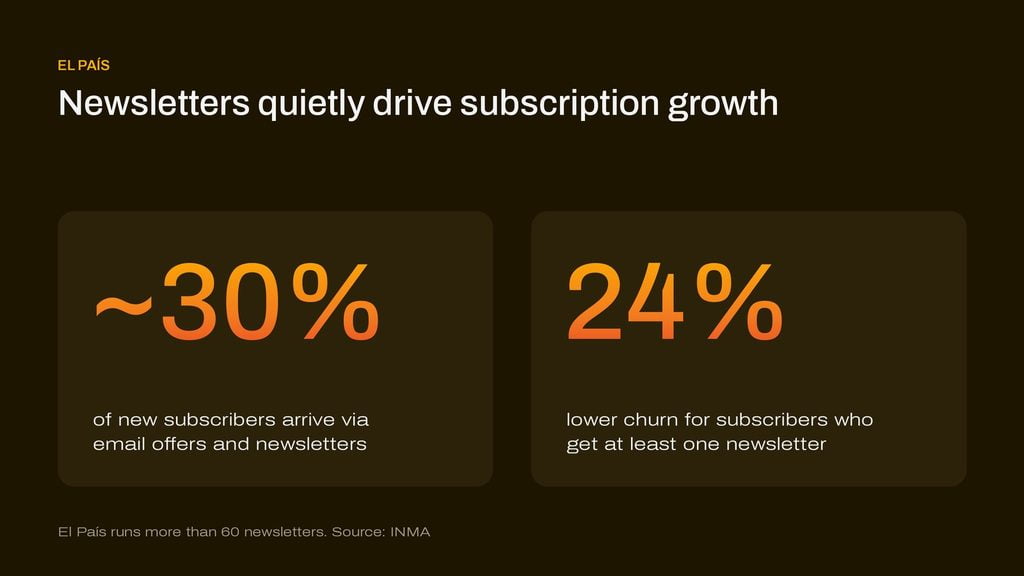
At the Spanish daily El País, about 30 percent of new subscribers come through email offers and editorial newsletters, and subscribers who receive at least one newsletter churn 24 percent less than average. El País runs more than 60 newsletters.
In my experience, newsletters work across continents and across newsroom sizes. Not everyone will subscribe to your newsletter, but the ones who do are giving you a strong signal, and you should listen.
Why does this one format convert so consistently? The newsletter is the only major format a reader invites directly into a space they control: their inbox. No algorithm decides whether it arrives. That’s the definition of an owned relationship.
Related articles
From text to audio and video
Podcasts and video get discussed in almost the same breath as newsletters these days, and there’s real evidence behind the enthusiasm. It just points somewhere slightly different.
News podcast listeners are unusually engaged: 71 percent describe themselves as extremely or very interested in news, against 45 percent of non-listeners, and 73 percent say podcasts help them understand issues more deeply than other formats. That’s according to the 2025 Digital News Report from the Reuters Institute.
Stated willingness to pay for news podcasts people already like runs between 39 and 46 percent in the markets tracked.
The Economist has turned some of that into an actual product: within six months of launching its Podcasts+ tier, it had around 30,000 people paying £4.90 a month, most of whom had never paid The Economist for anything before.
Increasingly, a lot of that listening happens on YouTube. In the United States, it’s now the single most-used platform for finding and playing podcasts, ahead of Spotify, and the same shift is visible in other markets.
YouTube has also become the second biggest platform for news overall, behind only Facebook, and the way people use it looks less like scrolling and more like appointment viewing. In the UK, adults spend 51 minutes a day on it on average, against 28 on TikTok and 20 on Instagram, and most YouTube visits are described as intentional rather than incidental.
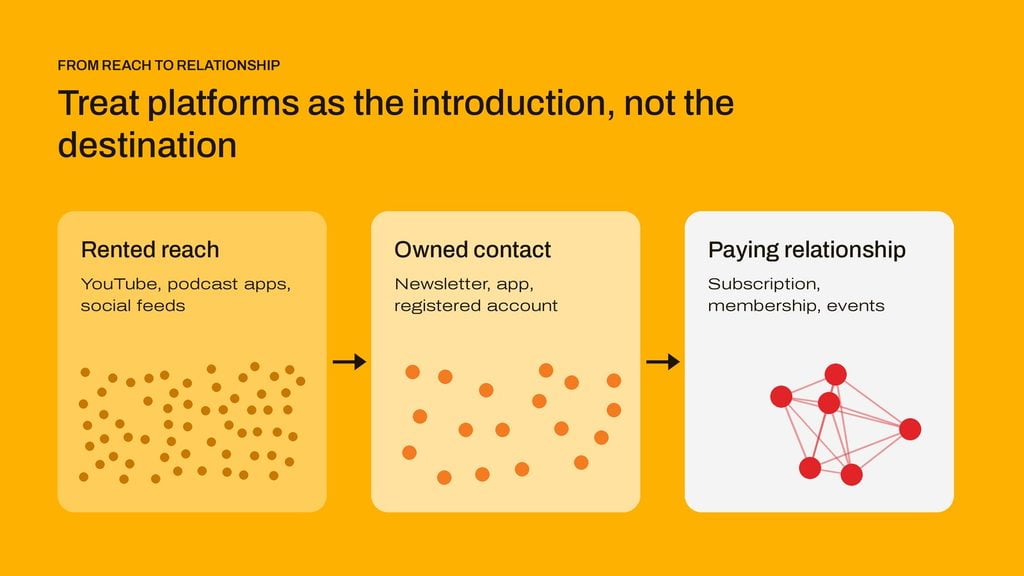
None of that makes YouTube an owned channel. It makes it a large, attentive, rented room. Across markets, video consumption is growing fastest on third-party platforms while it’s actually shrinking on publishers’ own sites and apps.
The publishers getting real value from podcasts and video aren’t treating them as a destination. They’re treating them as the introduction, and building the relationship on the back of it: bonus content, newsletters, membership perks that only exist once someone leaves the platform and lands somewhere the publisher actually owns.
The relationships that matter
The ugly truth is that more than 90 percent of your readers will never subscribe. And of the rest, only a smaller share will stay as long-term paying supporters. Still, it’s worth knowing that and keeping it in mind when charting plans for the future. You want to keep it real.
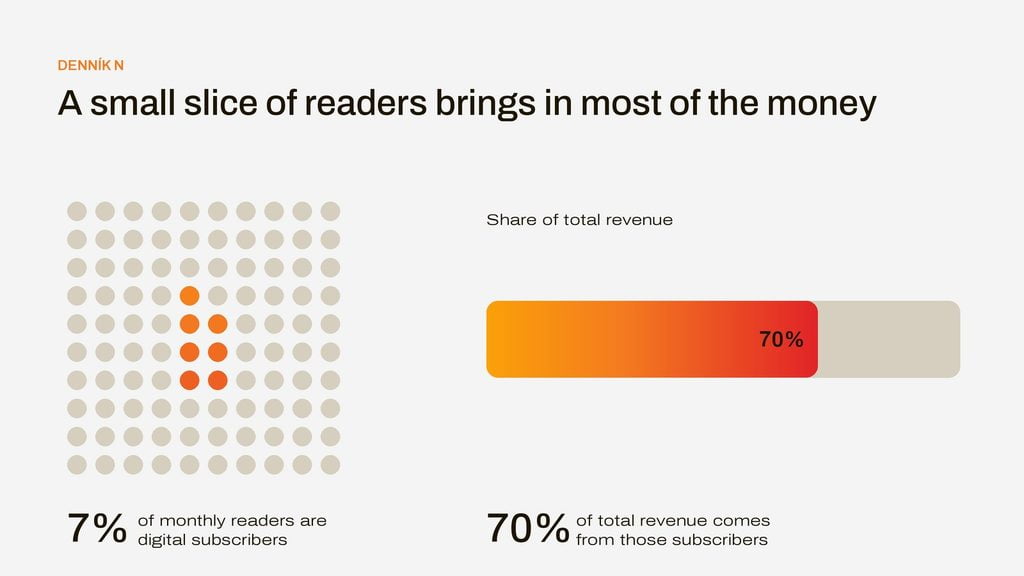
At the Boston Globe, digital subscribers generated 86 percent of BostonGlobe.com’s revenue. At Denník N, all digital subscribers, or 7 percent of monthly readers, generate 70 percent of total revenue.
Numbers like that should reset how any newsroom thinks about growth. The job isn’t to reach more people. It’s to give the people who already care enough reasons to go further: more formats, more access, more of a feeling that they’re inside something rather than watching it from outside.
If I had to narrow it down to a starting point, it would be three moves, roughly in this order.
First, find out which small slice of your existing audience visits most often and reads deepest, using whatever data you already collect, rather than guessing from instinct or job title.
Second, fix or build your newsletter before investing further in podcast or video production, since it remains the format most reliably proven to turn that slice into paying readers.
Third, treat every podcast episode or video you publish as a pitch for something owned: an email signup, a membership, a reason to come back to a site the newsroom actually controls. It shouldn’t be the finish line in itself. Think of what Wordle and the other games do for The New York Times: they give people a daily reason to come back. At the very least, every piece should deepen the relationship with the audience, not just build the brand.
The publishers leading our industry forward focus on owned audience because they’ve been burned before. Owning the relationship, with no algorithm or platform change standing between the newsroom and the audience, has become the holy grail for a reason.
In a sense, the most successful outlets have all followed this simple strategy. The unspoken part is that it took all of them years. Yes, on social media you can go viral overnight, but that won’t sustain you in any way.
Building a sustainable media business is increasingly about relationships that matter, and about spotting the other opportunities that make sense along the way.
Subscribe to our newsletter for more publisher stories and strategies straight into your inbox.
Enjoyed the post? Share it.

A journalist, podcaster and audience development strategist interested in the business of news.











FatChilli's Solutions