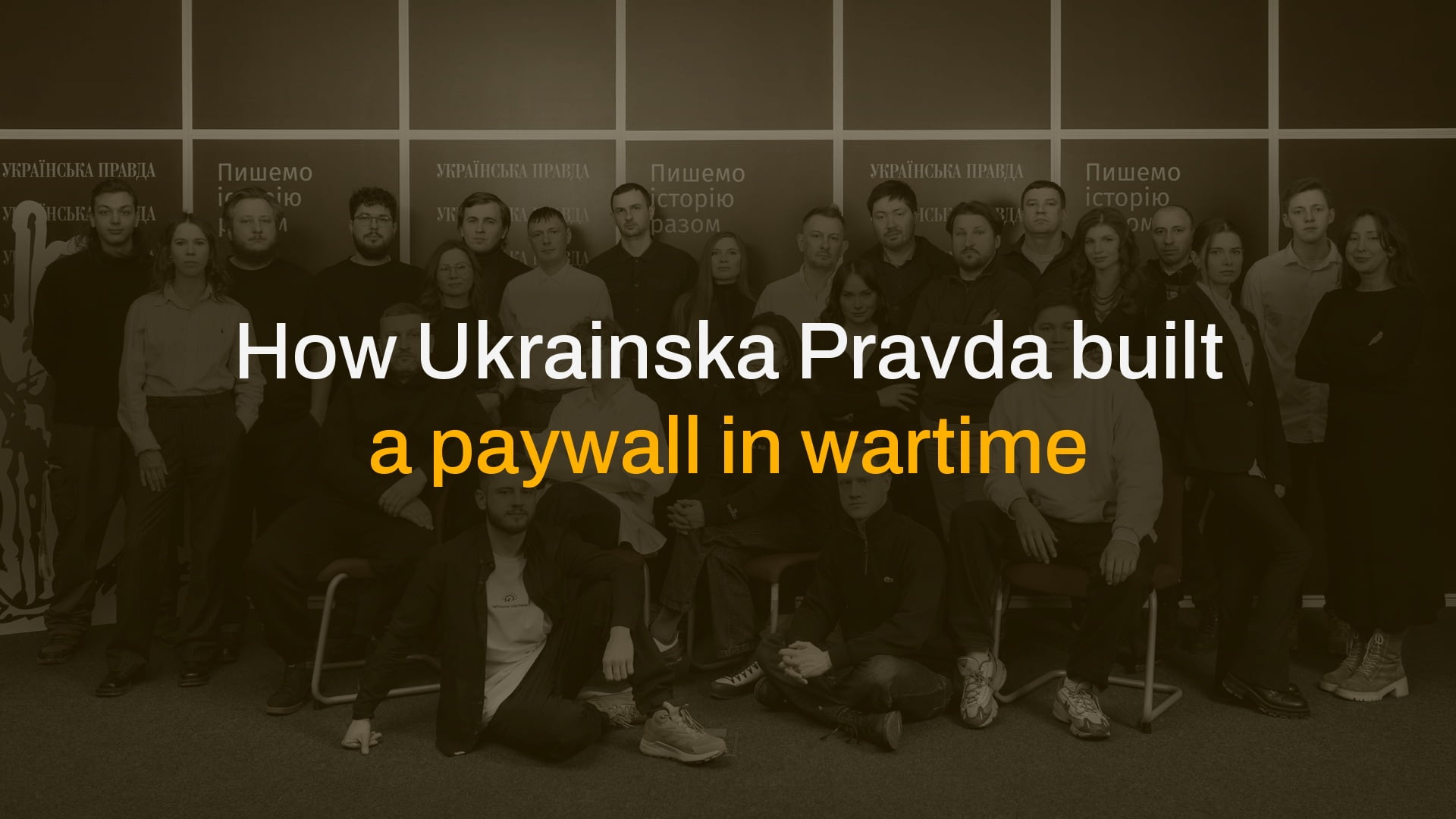

Ukraine’s largest independent news site launched paid subscriptions at the end of April, running on the open-source REMP platform built by Denník N. Executive director Andrey Boborykin talks about their editorial approach, digital strategy, shared numbers, and also what did not work.
Ukrainska Pravda spent the first three years of the full-scale invasion doing what almost every Ukrainian newsroom did. It chased grants, rebuilt an advertising business that had lost 90% of its revenue overnight, and leaned on platforms for reach.
Boborykin told the International Press Institute in 2022 that 95% of the newsroom’s revenue had come from advertising, and that it fell by 90% in the first two months of the full-scale invasion.
What carried them through the three years after that was a mix of programmatic advertising, donor funding, and revenue share from syndication.
Then two things happened. American aid, which had been sustaining around nine out of ten Ukrainian outlets, was frozen and then largely terminated during 2025. And Google traffic started falling.
In January 2026, the Dutch impact investment fund Pluralis took a minority stake in the publisher, the first institutional investment in independent Ukrainian media since the invasion began. Part of what the money was for, as The Fix reported, was launching and marketing a paywall.
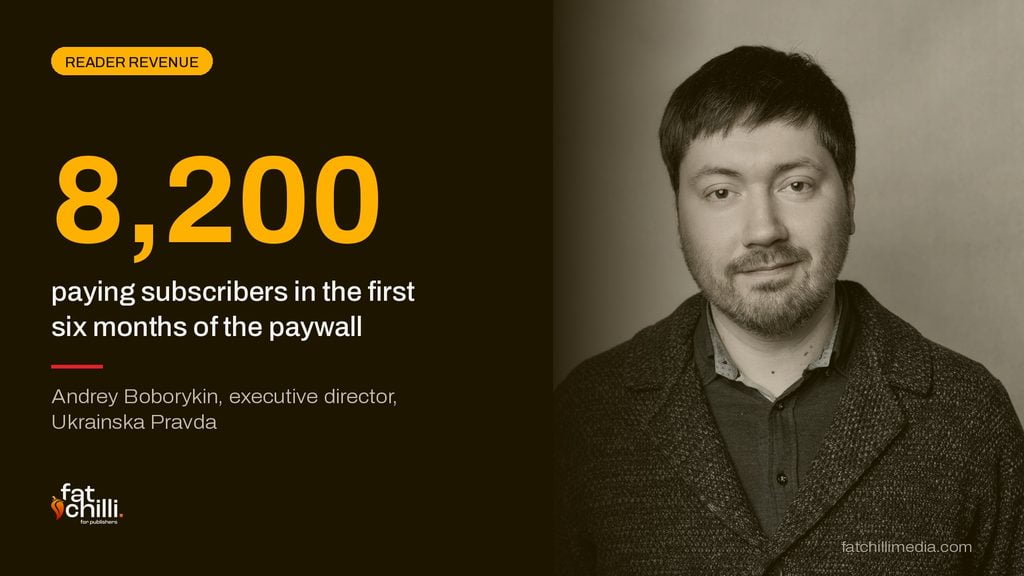
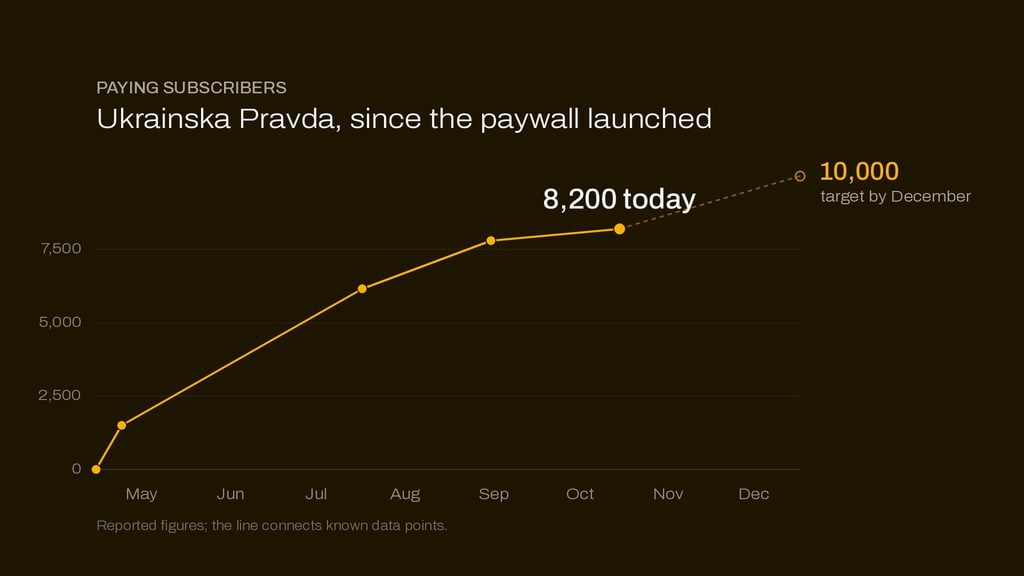
It went live on 29 April. We caught up with Andrey in mid-September; the number of subscribers was 7,800, reached after just four months. It is now 8,200.
“We’re doing okay,” Boborykin said. “The conservative plan for this year is 10,000, and right now it seems we are very close to this number. We’ll probably do more by the end of the year.”
Subscribe to our newsletterfor more publisher stories and strategies straight into your inbox.
The invisible work before launching a subscription
Initially, the paywall was supposed to go live at the end of 2025. But Ukrainska Pravda is not a single website. The publisher runs a group of them, structured a little like Vox Media, with separate verticals for economics, European affairs, defence, sport, lifestyle and tech.
The flagship outlet ran on one technical stack; some of the others had already moved to a different one. Before anyone could sell a subscription, all of it had to sit on one CMS, with one login that carried a reader across every property.
“We spent a year and a half bringing all the websites to one back end,” Boborykin said. Redesigns that had been overdue for years got folded into the same migration, because the pages were being rebuilt anyway.
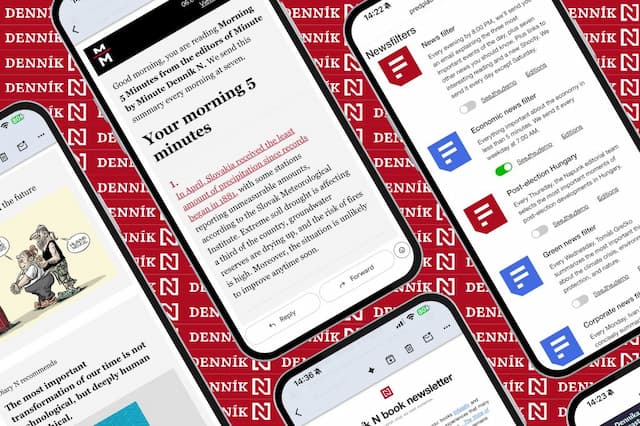
By the time the platform decision came up, it had mostly been made. NV.ua, which shares an owner with Ukrainska Pravda, had been running REMP – Readers’ Engagement and Monetization Platform for several years.
The team had access to a working implementation, and a direct line to Denník N, which is building and maintaining the platform together with FatChilli. Google News Initiative, which funded the original REMP build at Denník N in 2016, supported the Ukrainska Pravda adoption too.
“We specifically chose REMP because of the open-source nature of it, because we can build on top of it, and because it is free to use,” Boborykin said. “For a Ukrainian publisher, even the significant discounts on Piano or Poool are very significant money. So it just made no sense to use anything else.”
Three subscription tiers
Ukrainska Pravda offers three tiers of subscriptions:
- Basic is 149 hryvnia a month or 1,490 a year, around €2.90 and €29.
- Standard is 249 a month or 2,490 a year, roughly €4.80 and €48, and adds audio versions of articles and a site without display advertising.
- Premium is 999 a month or 9,990 a year, about €19.40 and €194, with access to the newsroom’s events and its closed video podcasts.
Readers without a subscription get ten articles a month across all sites
At first, the team had planned two tiers. The third came from Tomáš Bella, co-founder of Denník N, whom they consulted before launch.
“He suggested that since we have a big loyal audience, it would be logical to offer people an opportunity to support us in a bigger way,” Boborykin said, “even though there wasn’t any significant feature behind the third tier. There are a number of people who have money and who want to support Ukrainska Pravda in an easier way than we ask for.”
Denník N also offers three subscription tiers; the highest, named “Club N”, offers access to The New York Times, subscription sharing with three other people, no ads in the app or on the web, gift links to paid articles, a printed magazine and priority ticket sales for their events.
The launch itself went faster than the newsroom expected. In the first four days, Ukrainska Pravda signed just under 1,500 paying subscribers who together paid around a million hryvnia, or roughly €19,000. By the end of July, the publisher had 6,152 paying subscribers and 10,175 registered users, with monthly recurring revenue just under a million hryvnia.
Related articles
Discounts beat bundles
Ukraine’s reader revenue market is about six years old. The first paywalls appeared around 2020, when NV and RIA Media launched theirs during the pandemic. Understandably, price sensitivity is the defining feature of that market.
Boborykin spent most of the year before launch negotiating a bundle with one of Ukraine’s biggest streaming services, a product with more than a million paying subscribers. Both sides discounted heavily. The combined price still landed high, and the bundle has not performed the way he hoped.
What has worked is much less sophisticated. Two discount campaigns at 35 – 50% off, the most recent timed to Ukraine’s Independence Day, brought in more than a thousand subscribers each.
“The discount promo campaigns work the best, and much more effectively than product additions and bundles,” he said.
The next step is an always-on offer. Readers who hit the paywall and do not convert will be followed through paid social with a standing discount of around 20%, alongside targeted campaigns at the upcoming Black Friday and Cyber Monday, both of which are big retail moments also in Ukraine.
Whenever we have a big article about politics, an investigation, or anti-corruption, these drive the biggest signups. That content is very core to the DNA of Ukrainska Pravda.
Andriy Boborykin, Executive Director, Ukrainska Pravda
Great reporting wins conversions, helped by softer messaging
The business vertical was supposed to be a conversion engine. It was not. The pieces that convert readers into subscribers are the ones the newsroom was founded on in 2000, when Heorhii Gongadze started it months before he was murdered: political analysis, investigations, anti-corruption reporting. The team is now working out how to produce more of it.
Where the reader is when they decide matters as much as what they read.
“The act of subscribing happens only within a very native environment,” Boborykin said. “If a person is reading an article and sees the subscription offer, they are highly likely to subscribe. Anywhere else, on YouTube or at an event, it’s much less likely, because that person is not there to subscribe to anything.”
That has held true for events, which are otherwise a good business for Ukrainska Pravda. The newsroom ran several profitable ones in the first half of the year. Almost everyone who attends is already a subscriber, and the sponsorship-funded format does not lend itself to acquisition.
On messaging, the plan was to be pragmatic. Five years of membership marketing had been built on freedom of speech and independent journalism, so the paywall launched on access instead: more content, no ads, audio. Testing pushed them back toward the older register.
“People still react positively to the independent media messaging,” he said. “You cannot have purely pragmatic messaging.”
What raised conversion most was putting a face to it. Campaigns fronted by chief editor Sevgil Musaieva or by other recognized members of the editorial team, ideally on video, in their own words, outperform the rest.
The traffic problem underneath all of it
Ukrainian readers reach news almost entirely through platforms. Boborykin puts Google Discover, News and Search at somewhere between 50% and 80% of traffic for a typical Ukrainian news site. Over the last several months, he says, traffic across the market has been running about 40% below the same period a year earlier.
He does not think AI is the main cause.
“Most of this is not because of AI but because of the changes in Discover algorithms,” he thinks. AI answers hurt, but mostly on lifestyle and SEO-built content, recipes and how-tos and health explainers. For Ukrainska Pravda, he estimates it at maybe a tenth of the decline.
For a comparison, an analysis of Google’s AI answers in Slovakia showed lifestyle publishers have lost up to 70% of year-over-year traffic, mostly lost from Google Search, but political news outlets largely kept their search traffic.
A large share of Ukrainska Pravda’s search traffic used to be brand queries, and one of the biggest was the word “news” typed into a browser. People saw Ukrainska Pravda in the top three, clicked, and landed in the news feed. Now that query returns a large headline carousel built on Discover infrastructure instead.
“The Discover logic right now is very different from what it used to be, and no one can properly explain it, not even Google.”
The paywall made this worse before it made it better. When the metering went live, roughly 5% of the audience hit the wall immediately, a lot of them arriving from Discover and bouncing on the first page. Google cut referrals within days. Ukrainska Pravda loosened the paywall on news, and the traffic came back.
Boborykin does not expect the decline to accelerate from here. People still want a feed, and in Ukraine that feed is Discover. There is no Apple News to act as a counterweight.
Facebook sends money, but not traffic. YouTube memberships run in parallel
Facebook stopped sending Ukrainska Pravda meaningful traffic around 2023 and has come back as a revenue line through on-platform monetisation of video and photo content.
“Our biggest Facebook page in revenue is maybe even slightly bigger than our biggest YouTube channel,” Boborykin said, on programmatic. “It’s a surprise. We weren’t expecting that.”
The second is Telegram, which he thinks is too overrated as a disruptor. Its dominance in Ukrainian news consumption rests on channels run by people with access to radar data who post drone tracks in real time, a use case no publisher can match and most cannot even source.
Ukrainska Pravda’s channel has around 200,000 subscribers, carries no advertising, and exists so that readers who live on the platform can still find the journalism. The place he sees behaving like old Twitter in Ukraine is Threads.
YouTube is a business of its own. They reach roughly 26 million people a month in Ukraine, effectively the whole online population, and it is where television advertising money is migrating.
Ukrainska Pravda’s video department is profitable. It also runs a separate YouTube membership system around its political podcast, and a channel built around one of its political analysts, on revenue-share contracts. Access to the closed videos was added to the higher paywall tiers after subscribers asked for it.
The creator arm was partly meant to bring new talent in. That has not worked. “A YouTube creator starts on his own,” Boborykin said, “and by the time he has a project we could be interested in, he already doesn’t need us.”
“Emails as a thing are not big in Ukraine. We don’t have this newsletter culture yet,” he said. A daily newsletter with a dedicated team launched in mid-August and has a couple of thousand subscribers, entirely organic, with no marketing behind it yet. For contrast, Denník N built a 75,000-subscriber business with newsletters as its spine.
There is one more shift worth noting. By the end of the interview, Boborykin mentioned how the team is using AI at the moment.
It does help the editorial, but what has proved to be a better fit is creating their own solutions. Ukrainska Pravda has started replacing paid tools with ones it builds itself.
“We are trying to substitute a lot of the tools we pay for with tools we are building,” Boborykin said.
They have already done it with an analytics vendor that was expensive and slow to develop, and replaced it with editorial analytics coded in-house, which can read REMP data.
The team runs an MCP server on top of it, so individual team members can pull their own dashboards without filing a ticket with engineering.
Why the rest of the Ukrainian market is watching
Outside Ukrainska Pravda, Boborykin counts only three Ukrainian publishers currently running a paywall. Everyone else is waiting to see how it develops. Ukrainska Pravda has since extended the subscription to Ekonomichna Pravda, its business title.
“Every big national publisher is looking very closely at what happens with our paywall,” he said. “Once we reach 10,000, people in other media will start thinking about paywalls seriously.”
Independent media matters even if the nation is united by the ongoing war by Russia. And it doesn’t mean that the government is going to play nice.
In October 2024, the newsroom reported that the President’s Office was calling its advertisers and asking them to pull support. Six of Ukraine’s largest businesses withdrew from longstanding sponsorship arrangements.
Speaking of long-term sustainability, revenue coming from readers is harder to squeeze.
All in all, Ukrainska Pravda has achieved something unexpected in the toughest of conditions and there is probably no better measure to show how valuable it is other than the growing number of subscribers.
Subscribe to our newsletterfor more publisher stories and strategies straight into your inbox.
Enjoyed the post? Share it.

A journalist, podcaster and audience development strategist interested in the business of news.










FatChilli's Solutions