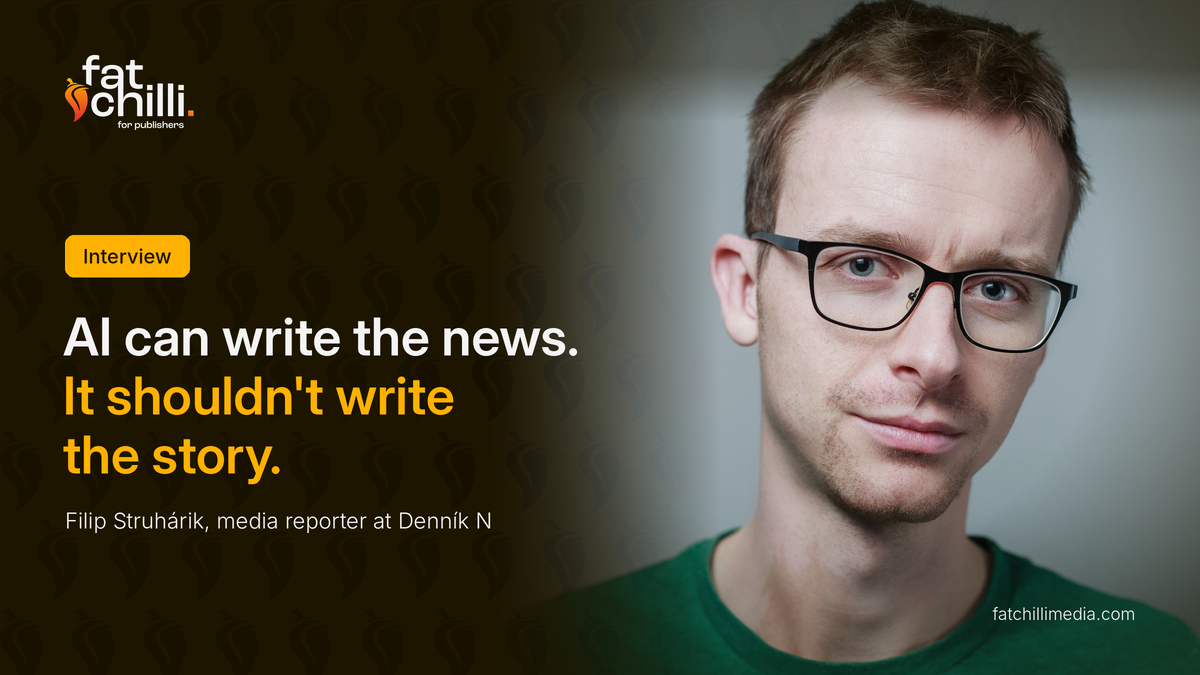

Filip Struhárik, Denník N
This interview first appeared on The Fix in the FixEd podcast as a collaboration with FatChilli. We talked to Filip Struhárik, a media reporter at Denník N, about how far newsrooms can take AI before readers stop trusting what they read. For publishers who depend on reader revenue, that trust is the business.
The conversation has been edited for length and clarity. The first edit was done by AI; the transcript was cut from roughly 9,000 spoken words to about 2,400.
How would you describe the relationship between journalists and AI right now?
Complicated, and a bit chaotic, because every newsroom has a different approach. In some, AI tools are still forbidden unless your boss allows them for a specific reason. Others use them heavily.
In my newsroom, there are early adopters, as everywhere. They started experimenting when ChatGPT came out and now have agents or tools that help with almost every task.
And some journalists don’t use it at all. Some are afraid it will destroy quality journalism. Some just don’t know how to start.
AI agents dominated the big tech conferences this autumn. Are they already coworkers in the newsroom?
It’s starting. A few journalists use AI for more than the small talk you have with a chatbot all day: shorten this paragraph, translate that, draft an email. They vibe-code their own tools for broader tasks.
But we don’t have data. I know people around me who are experimenting, but nobody has measured how advanced journalists in Slovakia, Europe, or globally actually are. In my experience, it’s becoming a thing.
Independent journalists, or creators, lean on AI much more. Research, editing, work that used to take a team. Let’s look at some test cases we laid out before this interview and see where we both stand: you as a member of a traditional newsroom and me, who is a part-time creator. First: AI writes the whole article draft from your prompt, the journalist edits it and publishes. Acceptable?
At The New York Times or The Washington Post, that’s off the table. I don’t think anyone at Denník N works that way either, though someone might surprise me.
We’re in a strange phase. On one side, you hear that if you don’t use AI, you’re lazy, you’re not progressive, the train is leaving without you. On the other, if you do use it, you feel like you’re committing fraud. So people use it and don’t say so, because they don’t know how their boss or their audience will look at it.
Today, most newsrooms would say no. I say yes, eventually. Not this year, maybe in five years, depending on the newsroom. But you have to think before AI writes anything. You need to know what you want to say, and you need the facts. If I ask AI to come up with the story and write it, I’m outsourcing all of my journalism. I don’t think any reader wants that.
📩 Subscribe to our newsletter for more publisher stories and strategies straight into your inbox.
Say you’ve done the reporting, talked to sources, gathered data. What’s the difference between handing your notes to an editor and handing them to an AI that has already learned your style?
That’s roughly what I tried this summer. I gave the models my recent newsletters so they learned my tone, my structure, and the topics I choose, then asked them to write the next edition.
It wasn’t bad. It wasn’t good either. It could simulate my voice and my template very well. What it couldn’t do was know what matters. Not just what happened that week, but what’s important to my readers and what they should take from it.
That’s why the thinking comes first. You decide what’s important and which points you want to make. Then AI can help draft. A language model doesn’t know what matters to your specific audience, whether that’s my newsletter readers or your podcast listeners.
I’ve had the same experience with curation. Even with your sources, I’d pick half the stories differently. But a single news story seems different. Take your recent piece onfalling traffic at Slovak news sites, down by as much as 73 to 74 percent year on year, which managers blamed on the record largely on Google’s AI Overviews. Once you’ve done the interviews, couldn’t AI assemble that?
I’d separate news from stories. News is the everyday material: a press briefing, a court ruling, an accident, a weather report, sports results. There’s little room for originality. If reporters from AP and Reuters sat in the same White House briefing, their copy would look similar.
Stories are reportage, columns, opinion pieces, even interviews, because an interview is the story of a dialogue between two people. Many are close to literary work. I’m 100 percent sure readers would feel cheated if they found out a personal story was written by AI. But in a few years they’ll be fine with AI writing the news about what happened in parliament today.
Related articles
Readers already push back when they find out. Opinion pieces by outside contributors at the Financial Times and The Wall Street Journalwere recently flagged by AI detectorssuch as Pangram, and theEU AI Act brings labelling rules. Right now people seem to want text that is either fully human or nothing. What has to happen for audiences to accept heavier AI use?
Time. Generative AI as we know it has been around for a few years, and people have seen a lot of AI slop on social networks. They’re angry about anything connected to AI. Time heals that.
If I know exactly what my story is about, my opinions, my points, what the first paragraph says and how it ends, does it matter that every word was typed by me? I don’t think it will in the future.
Today, there’s still pride. I think I’m a better stylist than AI. Sometimes I rewrite an AI-drafted email that was perfectly fine, just to show I do it differently. Call it ego. That will fade for news. For personal stories, it won’t. You don’t want to read a New Yorker piece written by AI. You read it for the reportage, as leisure reading, and you’d be angry to learn a model wrote it.
Some people will never accept AI writing, just as some never accepted short videos, podcasts, or listicles. But the majority will.
Some Slovak outlets now post Gemini Notebook-style videos on social media, and when I spot one, my trust drops. Denník N had its own phase with Midjourney cover images. The Fix reported in January 2023 that you were illustrating10 to 12 percent of articles a day with generative AI. How do you think about it now?
When generated images first became good enough, our strategy was: go wild, experiment, find out where the line is. Some days a big share of the homepage had AI images, and we felt that was too much. So we changed direction.
Now we use them for certain recurring topics where they’ve become a visual brand. Every psychological advice piece, for example, is illustrated by AI in the same style, so you recognise the topic at first sight. And we have a rule: no photorealistic AI images, only illustrations. Readers need to know what’s a real photo. Publishing AI photos would hurt their trust in everything we put out.
We even used AI illustrations on the front page of the print paper. Some readers were angry, but they’ve gotten used to it. For some stories, an AI illustration works better than a stock photo.
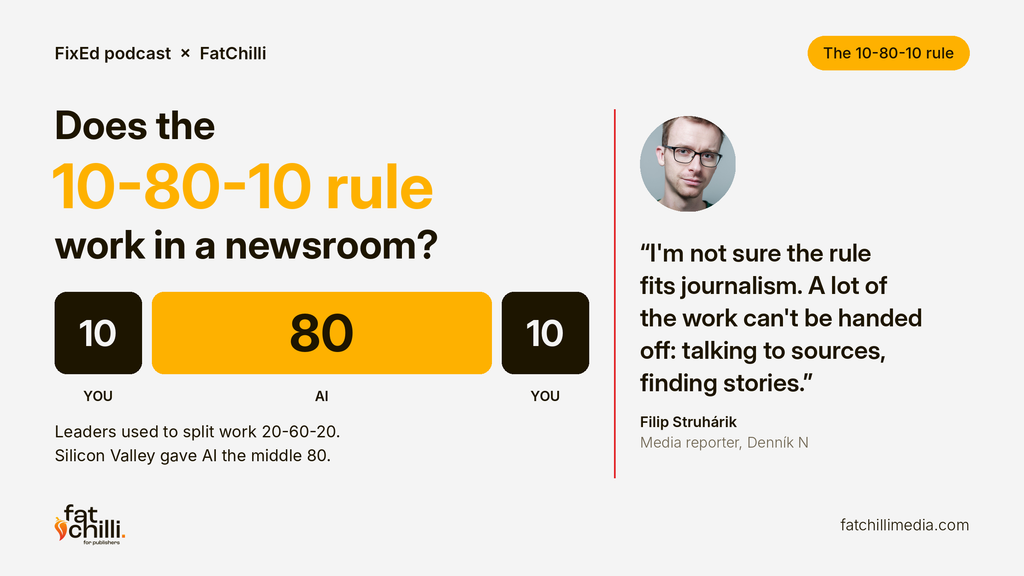
I think it was the author John Maxwell who coined this term, where he said good leaders use a 20-60-20 split: you lead the first 20 percent, the team does the middle, you come back for the last 20. Silicon Valley has turned it into 10-80-10, with AI doing the middle. Software teams already work that way. Where does journalism land?
I’m not sure the rule fits journalism. A lot of the work can’t be handed off: talking to sources, finding stories.
Take a podcast. AI can do almost all the preparation. It can suggest guests, write the invitation, propose topics and questions. But then you have to sit down and talk to the person. If you only ever asked the questions AI prepared, it wouldn’t be as good. There would be no passion, none of the provocative follow-ups that come from actually listening.
AI makes me more effective in some parts of my job. Other parts are more important than before, because of AI.
As a creator operating outside the newsroom, I go further with AI than I ever would inside one, and so do most creators I know and talk to. The audience reaction is the hard part. I once showed my wifea cardboard-cutout animation from TikTok. She loved it, until I told her it was made with AI. Then she hated it. Same video.
If I found out that your questions today were AI-generated, I would honestly be a little hurt, even though it’s irrational. You accepted the questions and decided they were worth asking me in person. But emotionally, it would feel different.
And I use AI to prepare questions too. I’d say reporters who refuse are choosing to be less prepared. I always start with my own questions and the arc of the interview: where we start, where we go, where we end. Then I iterate with AI. When a topic is crucial, I ask for five or six ways to put the same question, so I can go deeper.
As for creators, of course they’re more progressive. Most of them work alone and have to do everything, so they look harder for ways AI can help. Newsrooms have routines they’ve followed for years: the morning meeting, editors, fact-checkers, proofreaders. Every story passes through those steps, and they hold you in place.
If I went freelance tomorrow, I’d use AI much more, because I’d be building my routines from scratch. Newsrooms will change too, but it will take around five years. Routines are stronger than the will to change.
OK, let’s finish the round of AI examples and your take: Cloning your own voice to read your articles?
No. I understand it’s probably a lost battle, and voice clones will become the new standard. But my voice is my signature. It’s deeply personal. In a podcast, you’re in someone’s headphones; it’s an intimate relationship. If listeners can’t tell when it’s me and when it’s a clone, every next episode becomes suspect. It would save me hours. It would also undermine my credibility, whatever the disclaimer says.
Using AI to fix a guest’s photo for a thumbnail, adding a smile or turning a head?
Again, no. Sharpening, removing noise, upscaling to a better resolution: that’s normal editing. Changing someone’s expression, creating an emotion they never showed in the interview, that’s fabrication. It’s a deepfake, a visual clickbait. I write about disinformation. How could I criticise deepfakes and use them in my own thumbnails?
Magazines like the Czech weekly Reflex have run staged covers of famous people for years. Isn’t a thumbnail just the digital version of a cover?
With Reflex, every reader knows it’s a caricature. It’s the magazine’s style, like The Economist’s illustrations. A photorealistic deepfake on the homepage of The New York Times is something else. That’s why Denník N doesn’t use photorealistic AI images: it confuses what’s real and what isn’t.
YouTubers who use AI thumbnails are in entertainment. Even those who make journalistic content often don’t follow journalistic standards, because it’s a different business. It’s good that journalists have standards and stay strict about them. We shouldn’t drop them because others don’t follow them.
Last one. After the FT and WSJ cases, should newsrooms run every outside contribution through an AI detector?
Many will, for the next few years, because we’re still proud of handmade text. Some outlets may never allow AI-written stories, and that will be their badge of originality. I think The New York Times will go a very long time without AI text.
But media is a hard business. Most mid-sized and small newsrooms don’t have the people or the capital of The New York Times. They will use AI writing, and testing for it won’t make sense for them. Maybe for five or ten years, while we still think everything written by AI is slop. Then we’ll get used to it.
The difference between news and stories stays, though. If someone sends me a story from a war zone, I want to know that person wrote it. Not an AI pretending to be in the field.
Subscribe to our newsletter for more publisher stories and strategies straight into your inbox.
Enjoyed the post? Share it.

A journalist, podcaster and audience development strategist interested in the business of news.




FatChilli's Solutions